
Electron | Bridging The Swarm (NeonSat-1A)
Rocket Lab
Mission Status
Current date is a placeholder or rough estimation based on unreliable or interpreted sources.
Mission Updates
No more Rocket Lab launches in 2025.
Source →Reverted back to NET December TBD.
Source →Scrubbed for the day.
Source →Abort at engine ignition.
Source →Official Webcast by Rocket Lab has started
Source →Rescheduled for December 16 UTC.
Source →Reverted back to December TBD pending new launch date.
Source →Scrubbed for the day.
Source →Recycled for end of window.
Source →Hold at T-5:43.
Source →Official Webcast by Rocket Lab has started
Source →Updated T-0.
Source →GO for launch.
Source →Updated launch window per new NOTAMs.
Source →Added launch.
Source →Mission Details
The NeonSat-1A, carrying a high-resolution optical camera, is designed to test the constellation capabilities of the South Korean government's Earth observation micro-satellite constellation NeonSat (New-space Earth Observation Satellite), in particular technology improvements identified from operations of NeonSat-1 after its launch in April 2024. These technologies will in turn be incorporated into the next 10 NeonSat under construction, as well as providing more site re-visiting capabilities along with NeonSat-1. The NeonSat constellation is the first satellite system developed by the government using a mass-production approach for precise monitoring of the Korean Peninsula, lead by the Satellite Technology Research Center (SaTReC) at the Korea Advanced Institute of Science and Technology (KAIST), Korea’s leading university dedicated to science and technology. Designed to capture near-real time natural disaster monitoring for the Korean peninsula, KAIST’s NEONSAT constellation is a collaboration across multiple Korean academic, industry, and research institutions, including SaTReC, which is leading the program’s system design and engineering. The NEONSAT program is funded by the Korean government’s Ministry of Science and ICT (MSIT).
Rocket Configuration
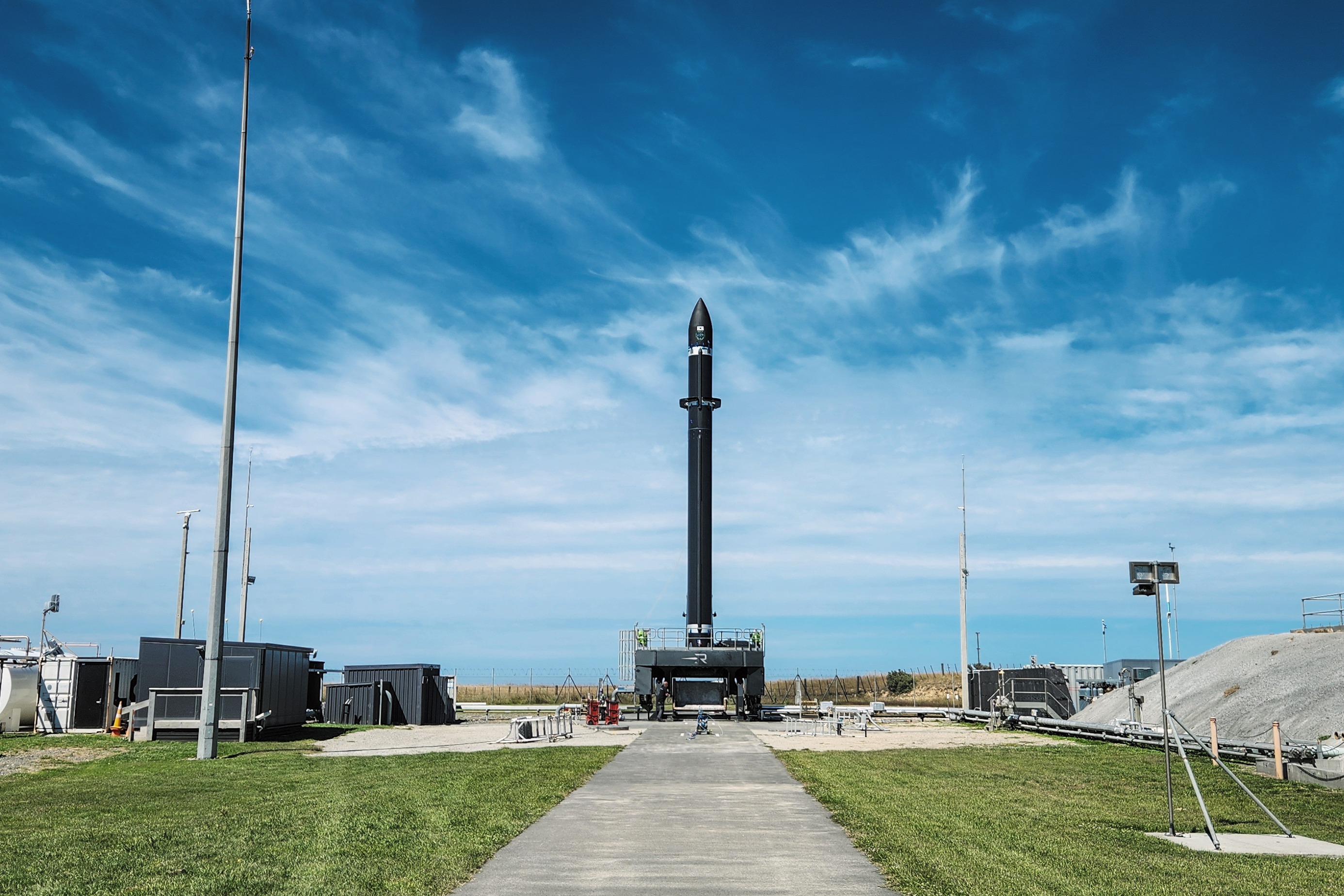
Electron is a two-stage orbital expendable launch vehicle (with an optional third stage) developed by the American aerospace company Rocket Lab. Electron is a small-lift launch vehicle designed to launch small satellites and cubesats to sun-synchronous orbit and low earth orbit. The Electron is the first orbital class rocket to use electric-pump-fed engines, powered by the 9 Rutherford engines on the first stage. It is also used as a suborbital testbed (called HASTE) for hypersonics research.